By Marina Garcia Alacreu (LLM class of 2025/26)
“We were born into an unjust system; we are not prepared to grow old in it” (Bernadette Devlin)
Fifty-four years ago, on 30 January 1972, the Northern Ireland Civil Rights Association organised a protest against internment without trial. On that day, British soldiers from the Parachute Regiment opened fire on unarmed civil rights protesters, resulting in the murder of fourteen people and injuring many others. This became one of the most significant and controversial events of the conflict period in Northern Ireland. Since then, for the annual march, families, neighbours, and people in solidarity travel to Derry to support this long search for truth and justice. That’s what we did too.
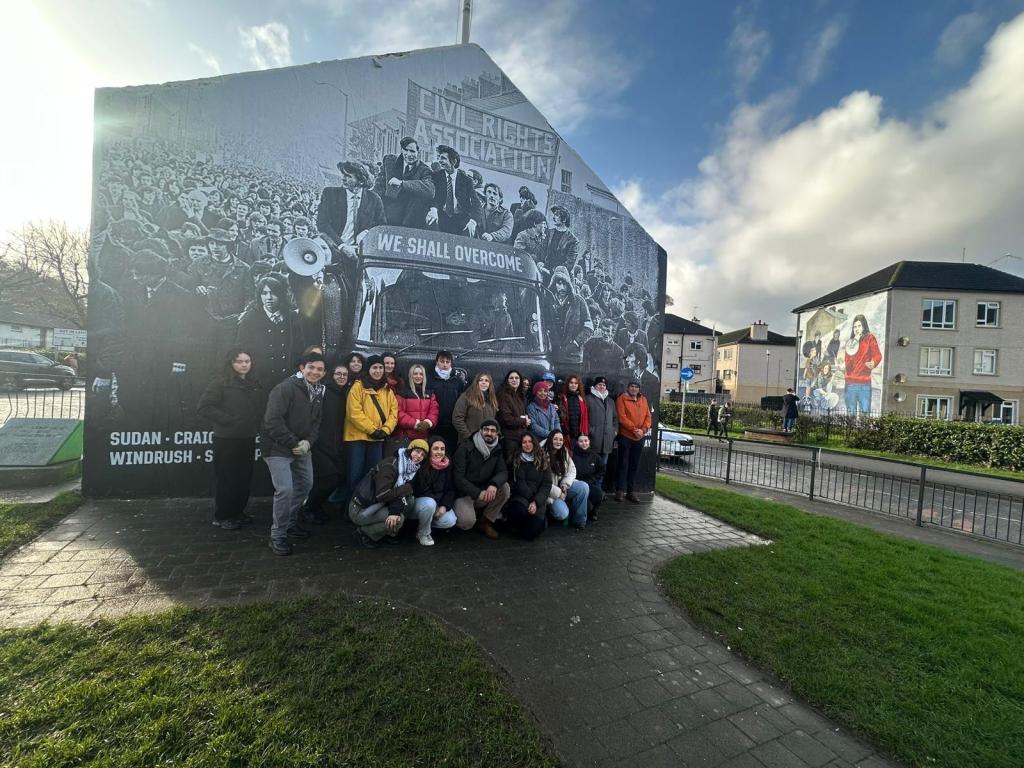
On the last weekend of January, just after our class on Transitional Justice, a group of LLM students from the Irish Centre for Human Rights travelled to Derry for the Bloody Sunday Commemoration weekend. Our group mostly comprised of international students, but also included several Irish nationals, all eager to show support and solidarity, and to learn more and get involved in human rights issues.
Thanks to an LLM student who is also a human rights solicitor with close ties to people involved in the commemoration weekend, our time in Derry was full of learning opportunities. Our first activity was on Saturday morning upon arrival at the emblematic Pilot’s Row Community Centre in the Bogside, a neighbourhood outside Derry’s city walls. While preparations for the annual Derry Radical Bookfair were underway, we had the pleasure of meeting with Shane O’Curry. He has been active in human rights organisations in Ireland for many years and currently works as Director of the Irish Network Against Racism (INAR).
Shane is also a former member of the Pat Finucane Centre (PFC), a non-party-political, anti-sectarian human rights group advocating for a non-violent resolution of the conflict on the island of Ireland. He worked for years on issues related to transitional justice in the region, especially after the Good Friday Agreement.
In explaining the Centre’s work, he described fifteen years of research in which they unmasked the Glennane gang and showed how it operated during the 1970s. The investigation revealed that some members of the Royal Ulster Constabulary (RUC), the Ulster Defence Regiment (UDR), and loyalist paramilitaries formed this group and were involved in the deaths of almost 120 civilians. This provided evidence of collusion by the British State in atrocities. This lengthy research culminated in the book Lethal Allies (2013) and the subsequent documentary Unquiet Graves (2018).
Shane also gave a powerful account of the community experience after riots in Derry between 10-14 July 1996. It was a remarkable effort which involved weeks of community processes to gather information – including compiling more than 100 testimonies from neighbours – to highlight the abuses and denial of human rights over the period. Shane emphasised that their exhaustive research was important in public discourse because it enabled key policy changes, such as police reform. In addition, he highlighted that the most significant learning from these projects remained the possibility of changing narratives of oppression through community development processes and truth recovery campaigns with project participants, while offering contextual appreciation of tragic events from the perspectives of families, victims and survivors themselves.
After that, we went straight to the panel talks, where parallels between the occupation of Palestine and Northern Ireland were discussed. Activist, writer, and comedian Tadhg Hickey, a member of the Global Sumud Flotilla, spoke about comedy and satire as tools for strengthening revolutionary narratives. Stephen Devlin, father of Jordan Devlin – a young man imprisoned in the UK for opposing the ongoing genocide in Palestine – talked about non-violent actions and the criminalisation of the twenty-four Palestine Action activists. In the same space, longstanding activist Sheila Coleman, a Hillsborough justice campaigner, discussed the importance of solidarity networks among truth-seeking advocates in Ireland and worldwide.
While at Pilot’s Row Centre, some of us had the pleasure of bumping into Bernadette Devlin, one of the most prominent figures in the civil rights movement during the late 1960s and early 1970s. At the age of twenty-one, she became the youngest woman ever elected to the British Parliament in 1969. Devlin’s political career was marked by her fierce belief in Irish self-determination and strong arguments against British troops’ presence and suspected abuses by security forces. She was one of the organisers of the 1972 Bloody Sunday march and still usually attends it.
For the day’s final talk, family members of Bloody Sunday victims shared their stories. We heard from Liam Wray (brother of James Wray), Geraldine Doherty (niece of Gerald Donaghey) and Sussane McKerr (granddaughter of John McKerr), alongside Eamonn McCann, a well-known political activist, writer, and former politician.
One central topic was the two separate inquiries into Bloody Sunday. The first, carried out right after the incident, was conducted by John Widgery, Lord Chief Justice of England from 1971 to 1980. Widgery heard testimony from soldiers who claimed they had been shot at, while marchers insisted no protesters were armed. His report, published in April 1972, largely cleared the soldiers and British authorities, blaming the victims themselves. This narrative – widely considered a whitewash – became the official version, and the stigma of association with Bloody Sunday persisted for years.
Family members shared that after many years of fighting for the truth, a second inquiry was finally established in 1998, known as the Saville Inquiry. Lord Saville and fellow judges heard evidence from 921 witnesses and considered 1,500 other statements. Lasting twelve years, it published its report on 15 June 2010, finding that all the dead and wounded were innocent. The report concluded that the killings were “unjustified” and “unjustifiable”, with none posing a threat, and soldiers firing first at fleeing unarmed civilians.
The Saville findings marked a significant step in the quest for justice, contradicting the conclusions of the Widgery Tribunal and helping to decriminalize victims. Official apologies followed from then Prime Minister David Cameron, who stated, “it seemed to me that those words [unjustified and unjustifiable] best summed it up […] what happened was wrong, full stop”. The report was broadly welcomed and celebrated by families despite some disputed nuances, as relatives in the room noted.
But in the fight against impunity, the victims’ relatives were not satisfied, as nobody was held to account and prosecuted, so impunity seemed persistent. Especially this year, after Soldier F’s trial, the wound was particularly painful. Most speakers were disappointed by his acquittal, and some reflected on the role of families in trials, feeling that they were still not being heard.
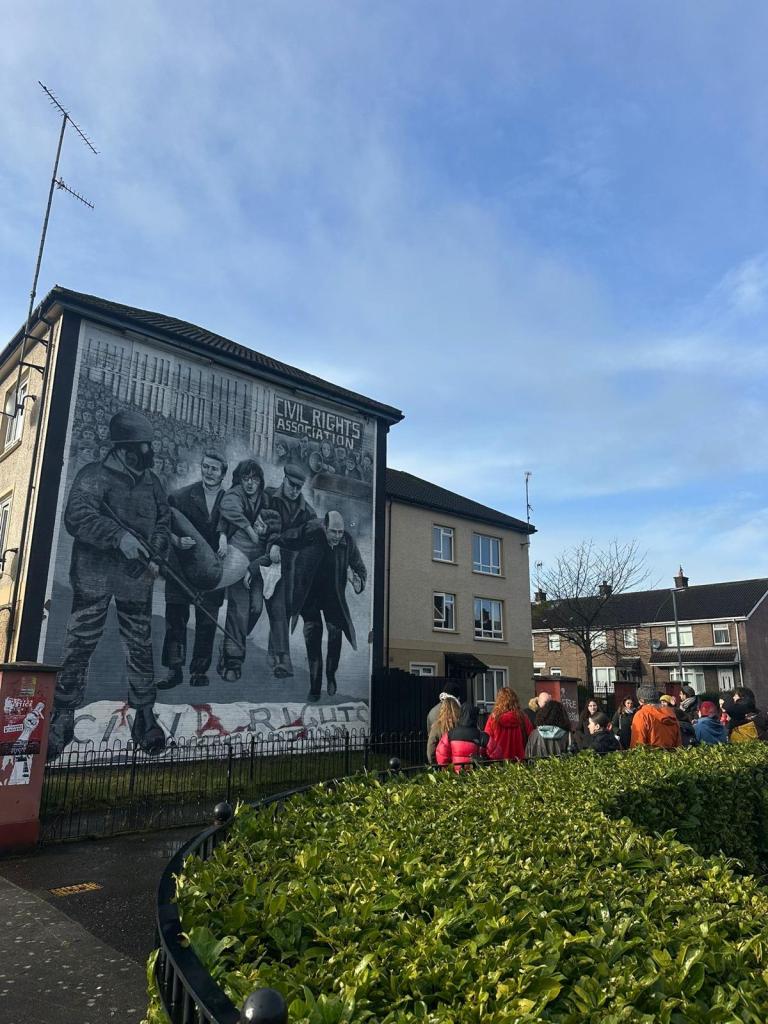
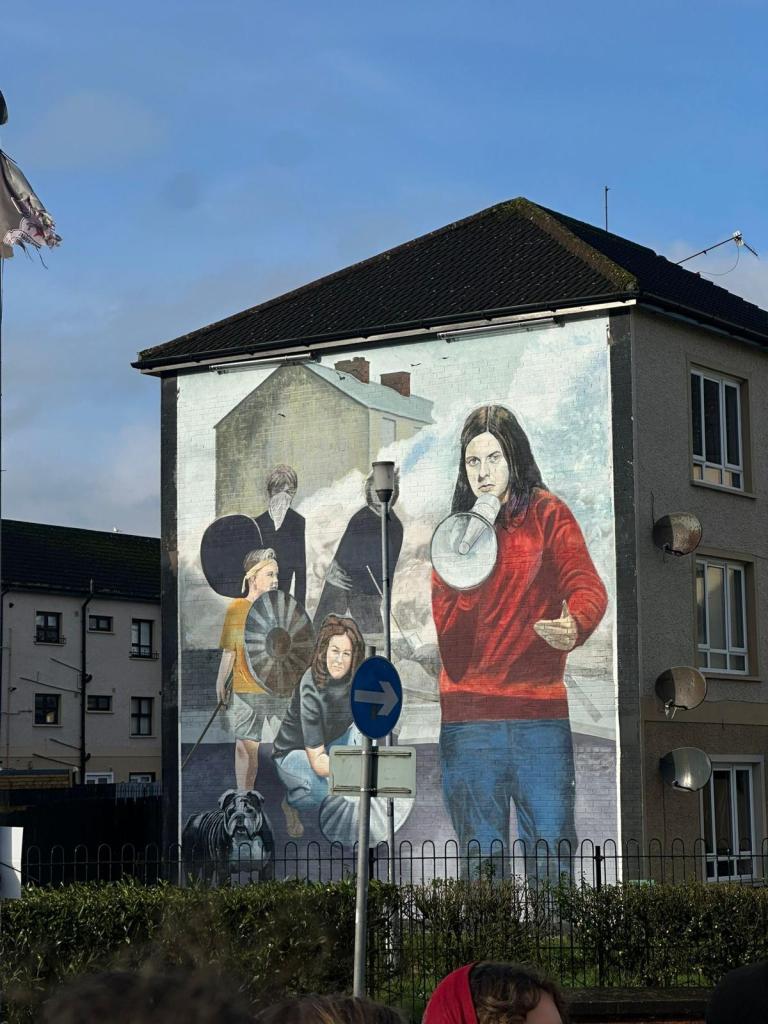
The next morning, we met at the entrance of the Museum of Free Derry for a guided tour of the Bogside – site of the Bloody Sunday murders and now memorialised through a series of murals. Alongside the tour, our guide explained key moments depicted, such as early civil rights marches, Bernadette Devlin’s image, the Battle of the Bogside, Bloody Sunday, republican hunger strikers, and other events of the Troubles. Our guide, a local Derry man, shared his personal history and answered all our questions. Though it was not an easy task to share as much as he did, we were very grateful for what he gave us to reflect on.
Finally, we visited the Free Derry Museum and joined the Bloody Sunday March on Sunday. It featured performances of remembrance like coffins bearing victims’ names, alongside anti-imperialist slogans, republican memory bands, working-class rights advocates and other banners.
I guess that even if you come from a different country and have not experienced the pain of the Troubles firsthand, being in a place of such awful events stirs deep feelings. It’s clear how difficult the healing process is for societies scarred by armed conflict. In the North of Ireland, the post-conflict political and social context remains complex, with sectarian divisions still persisting and much work still needed for healing.
As victims’ families said in the forum, what does justice mean? This classic transitional justice question is often hard to frame. For some, the Saville Inquiry was a triumph; others felt no full relief. What did the British State’s public apology mean for them? What if nobody is held accountable? A victim’s brother recalled years of suffering and a sense of impunity. He also stressed the importance of youth. Without confidence that prosecutions would continue, he said: “For me, justice means… a history book that tells the stories… justice is exposing them.” As a victim’s granddaughter said: “The next generation is trying to fight, we want to move on, but we want truth and justice”.
This trip started as an opportunity to learn more about the Bloody Sunday massacre and the processes that follow grave human rights violations. What is certain is that the context of transitional justice is very complex. Opinions often differ, and ways of healing and moving on vary for everyone. So, we returned to Galway with much food for thought. At the end of our trip, Shane O’Curry’s opening phrase resonated more: “Derry taught me more than any university.”
Students’ perspectives and thoughts:
- “The trip was one of the best theory-practice exercises I had when it comes to the question of transitional societies and post-conflict societies […] coming myself from an unresolved conflict/war zone, it was quite mind-opening to see how societies can move forward despite the history of violence and common hostility. […] I noticed that support for Palestine in Derry was more visible than in other, perhaps equally supportive cities in the island of Ireland. This made me think that people that have suffered from oppression not only feel inclined to support other oppressed people but rather identify their own struggle with the struggle of others.”
- “It was so interesting to learn about how Derry’s people memorialise this march while my country erupts into protests of its own… Like the people of the U.S. are protesting, and people are dying. I don’t know what’s coming for us. I don’t know how to describe what it feels like, honestly…”
- “From my perspective, having been to Derry for the Bloody Sunday murders anniversary weekend several times before, travelling with the Masters group and engaging in conversations and trying to answer questions, it was like attending the Derry anniversary for the first time – again. It was particularly insightful for me, given that we travelled to Derry straight after the TJ class. […] It was fantastic to attend with my classmates, who brought different insights and perspectives from all over the world.”
This blog post represents the views of the author. For more about the ICHR’s LLM in Transitional Justice, Human Rights and Conflict, see here.
 Irish Centre for Human Rights Blog
Leave a comment